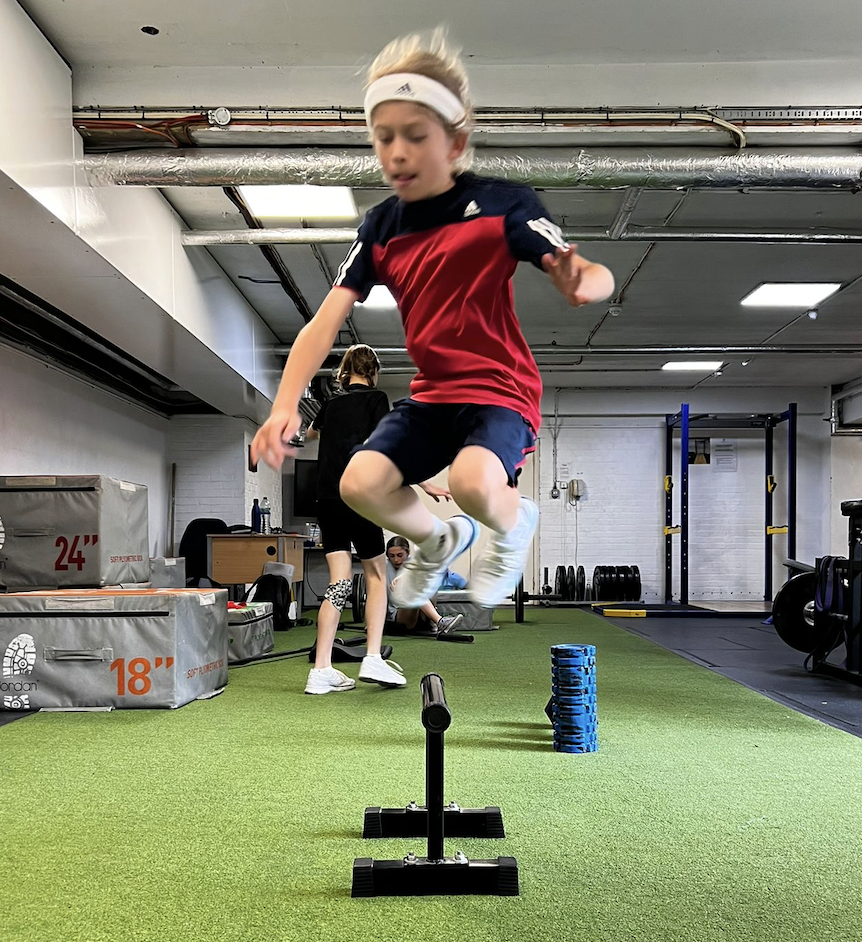

Jump Testing at Move4Sport: Using ForceDecks to Assess Athletic Performance
JUMP TESTING
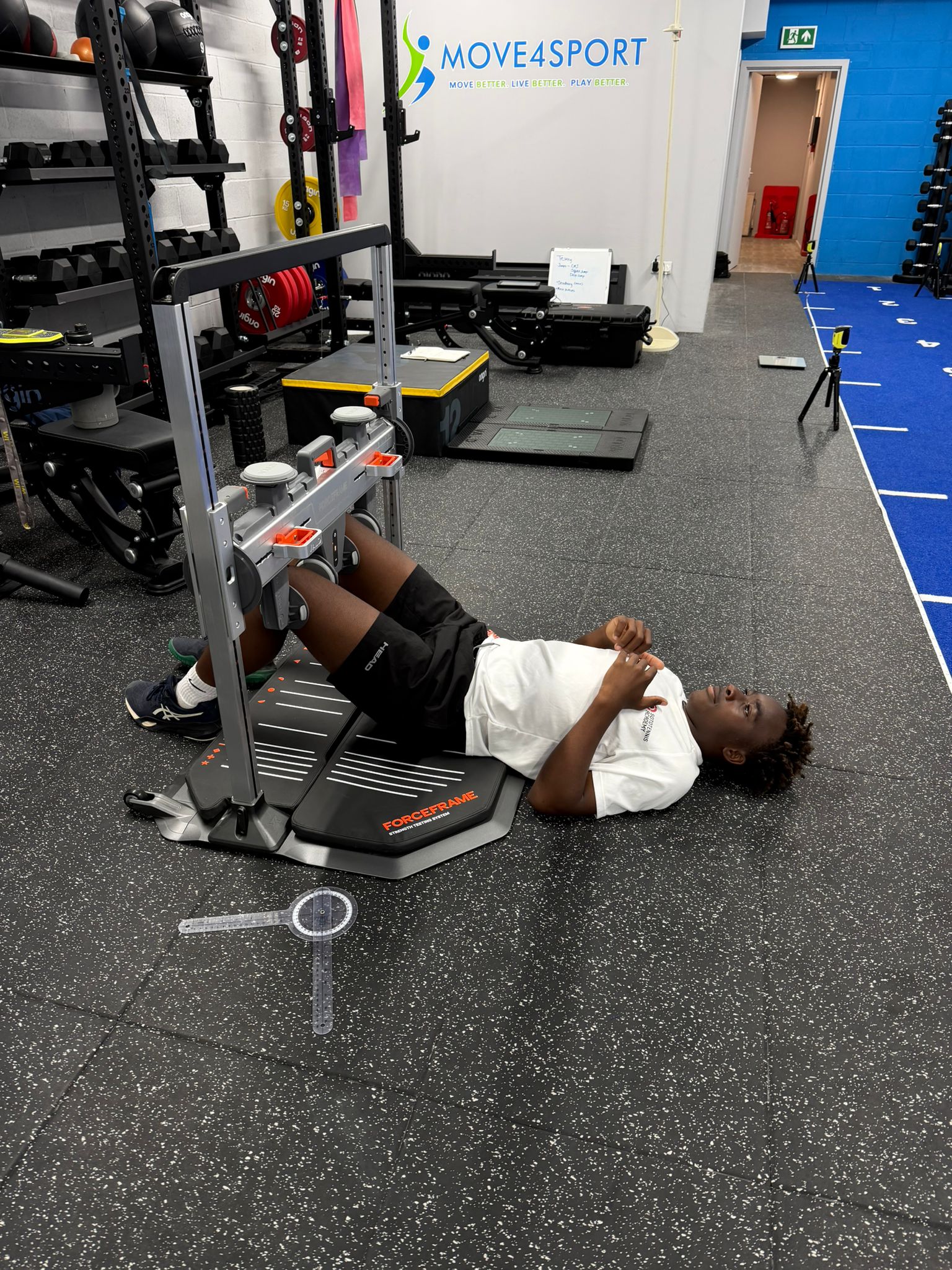
Alongside our new Move4Sport gym opening, we’ve continued to invest heavily in our coaching resources. The ForceDecks from VALD are used at Move4Sport for a multitude of important tests. As part of our mandatory screening and ongoing performance testing, we put the majority of our athletes through a battery of jump tests; the ForceDecks allow us to collect vital information that would otherwise be extremely difficult to quantify objectively.
We commonly use three jump tests: a countermovement jump (CMJ), a squat jump (SJ), and a drop jump (DJ). These three tests help us understand how each athlete produces force and power.
- Countermovement Jump
The CMJ is a vertical jump that involves a rapid downward movement immediately followed by an explosive upward jump (VALD) and has a vast amount of peer-reviewed research backing its effectiveness in evaluating lower body power, neuromuscular fatigue, and factors associated with injury risk in athletes of all ages. It is highly trusted in performance and rehabilitation settings, as it provides a snapshot of the entire range of muscular action.
Your coaches at Move4Sport readily track measurements on the force plates, looking at both performance metrics and jump strategy metrics. A simple overall metric that tells us how good you are at producing explosive power in a jump is jump height.
However, two athletes can jump the same height but have a completely different strategy. Here are some additional metrics we take that help us understand you as an athlete:
- Contraction Time
* A longer contraction time (time from the start of the jump to take-off) may indicate an athlete relies more heavily on muscular force production than elastic or reactive qualities. It may also reflect a deliberate strategy during rehabilitation, where exposure to high reactive forces is being carefully managed.
- Peak Braking Impulse
* A key indicator of an athlete’s ability to generate force during the braking (downward) phase of the jump before redirecting momentum into upward propulsion. This is especially important for our court and field sport athletes, who need to be able to decelerate, turn, and reaccelerate as quickly as possible.
- Net Concentric Impulse (@ 100 milliseconds)
* The amount of upward/accelerative force you produce within 0.1 seconds. Depending on the athlete, we may use a higher bracket (0.2 seconds or 0.3 seconds), but the message is clear: in many sporting actions, the ability to produce force quickly is just as important as the amount of force an athlete can produce. Increasing your rate of force development may be the missing ingredient to achieve that swimming PB, quicker serve speed, or faster first step.
Before we can create a targeted programme, we like to get more context.
- Squat Jump
The SJ isolates ballistic (explosive) muscle action, as instead of a rapid transition the athlete must hold the bottom of the jump for 3 seconds to eliminate all momentum created in the downward (braking) phase of the jump. On a coach’s "go" command, the athlete jumps as high as they can.
Using a combination of the CMJ and SJ, we can better understand whether an athlete relies more heavily on muscular force production or elastic/reactive qualities, how powerful their jump is, and identify any potential asymmetries or areas that may warrant further investigation. We can use this data to help tailor your programme to your chosen sport, as your sport may demand building reactive qualities over muscular ones, or vice versa.
As the ForceDecks track output from both legs, we can also examine how force is distributed between each leg during take-off and landing, helping us identify asymmetries that may warrant further investigation. In other words, if you take 70% of the landing impact on your right leg, we know we need to dive deeper into why.
We can also isolate each leg and perform any of the three jumps explained today as a unilateral (single-leg) test
-Drop Jump
Last, but certainly not least, is the drop jump. The DJ assesses the reactive strength of an athlete, involving a drop off a box and an immediate rebound into a vertical jump.
The reactive strength capability of an athlete, which is commonly recorded as their Reactive Strength Index (RSI), uses jump height divided by ground contact time (the time spent on the force plates before taking off) to create a score that reflects an athlete’s ability to rapidly switch from the braking phase to the propulsive phase.
As previously discussed, many sporting movements rely on the speed of force production. Reactive force production is heavily influenced by the stretch-shortening cycle (SSC)—a rapid stretch of the muscle-tendon unit, where elastic energy is stored within the tendons and connective tissues before being released during the subsequent contraction. This process allows force to be produced more rapidly and efficiently than through muscular contraction alone, which is massively important for sporting actions that need to happen as quickly as possible.
During maximal sprinting, elite athletes may spend as little as 0.08 seconds on the ground. In such short timeframes, performance depends heavily on the ability to rapidly generate braking forces, store elastic energy within the muscle-tendon unit, and transition into propulsion through the stretch-shortening cycle.
With the neuromuscular system being very sensitive to fatigue, the drop jump is also very valuable in fatigue monitoring, where a significant drop in performance (our RSI score) may be a cause to manage training load more closely. However, this goes back to our point on "jump strategy"; an athlete may produce the same RSI score, but looking closely at the ForceDecks data, we may observe a change from their normal strategy.
A fatigued athlete who normally adopts a more shallow squat into a quick reversal and jump may display a slightly deeper, slower, more muscularly driven jump. Where they increase their ground contact time on the force plates, they attempt to make up for it in the height they jump. If successful, a similar RSI score may show no change.
However, by looking into the individual metrics that illustrate jump strategy (which for the drop jump test are ground contact time and jump height), we are able to gain a much clearer picture of an athlete’s current neuromuscular status and whether training load may need to be adjusted.
.jpeg)
.jpg)

%20(1).jpg)